
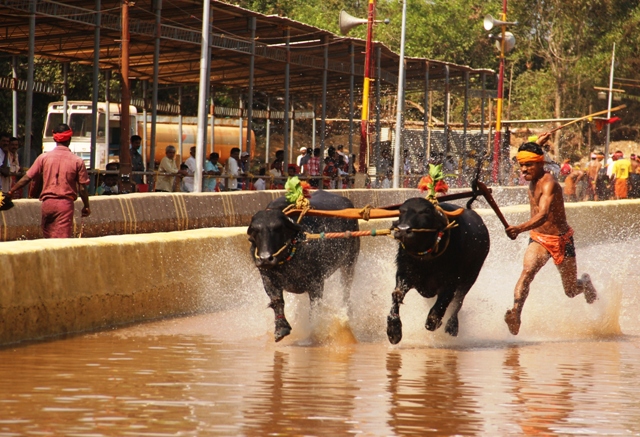
The air is thick with tension for the few seconds, before a crowd erupts into a deafening cheer as the whip-lashing farmer and his buffalo dash past, creating a muddy wake around them. It takes some time for the duo to find their apt starting rhythm and then in a matter of seconds, it’s over. Top pairs take as less as 11 seconds to complete the race along with a large contraption of a hull and ropes, running in 160 meters of slush. The lowest timing for a 100 meter dash has been recorded as 9.58 seconds in the world. Such is the level of sporting mettle at display at the Kambala Buffalo Races!
While animal rights activists and social police in general have cried themselves hoarse, their voices only seemed to have drowned under the incessant whiplashing that comes with the sport. After all, a thousand years old tradition cannot be influenced or adulterated by the modern contextualisation of the practice for the villagers of South Canara, who passionately compete at the buffalo races as the harvest season ends. Kambala Buffalo Races are a pride of the region, mainly the coastal districts of Mangalore and Udipi, where more than 150 pairs of athletically bred buffaloes are pegged against each other over a three month festive period. The word ‘Kambala’ literally translates into ‘muddy field’ in Tulu, the cusp language spoken on the Karnataka-Kerala border.
The Kambala Races go back to over 1000 years into history, when they were held to symbolize gratitude towards the Gods for a productive harvest and blessings for the future months. As most Indian rituals, this tribute too was interwoven with the importance of agriculture in the region of Tulunadu. The water buffaloes were an intrinsic part of the prepration of the fields and thus became part of the custom. Even though agricultural practices evolved over time, the buffaloes still remained important to the farmers as livestock and the leading heroes of these races. Till date, the animals are prized possessions and are maintained meticulously with suitable feeding and training. Patronage from wealthy landlords has shifted to industrial sponsors in some cases making the sport slightly lucrative for the owners and the local athletes who guide the animal. Numerous villages host the event on consecutive weekends from December to February.
Typically, a Kambala track is a basic dual path of about 160 meters, ploughed into a field. Water is poured before the race, making the soft mud even harder to run on. The two day race starts with a small ceremony at a specially erected pole in the middle of the two tracks. It is said that this pole, also known as a ‘pookare’ in Tulu, wards off evil spirits at the races and ensures that proper conduct governs the passionate sport. The team of buffaloes, runners and the owners then parade through the slushy tracks to make it soft. Different levels and types of races are held over the day and night, leading upto a grand finale the next morning. Frenzied crowds flank the tracks as the heavy weights bellow past them, egging on the animals with a combination of lashing and shouting. The end of the track elevates into a ramp to break the speed. As soon as the person finishes, the buffaloes and the runner are doused in water to cool down by other team members. A long day of heats and different levels of races ends continues overnight under halogen lamps. By then the animals are sore with lashes and the racing men are fatigued, yet consumed with competition. Entire villages attend the sport with interest – the region comes to an almost stand still while the races are on. A popular Kambala garners a crowd of more than 20,000 people in some cases.
Social accolades and honour apart, the winners are awarded with 4-8 grams of gold, depending on the organizing committee and financial muscle for that particular village. The owners of the buffaloes spend much more than that on the rearing and upkeep of the animals to cultivate them for races. Much like other indigenous sports like the snake boat race in Kerala and camel racing in Rajasthan, this too evades monetary gains even after displaying such prowess and risk on the tracks. With the negative publicity received in the urban circles of animal welfare, it is highly unlikely that the sport will get any sponsorship from financial honchos. While it seems unlikely that the spirit and sense of tradition will dwindle from the region, the question of channelizing the sporting talent towards national level will always be left unanswered.
Planning a trip: The races are held under the banner of the Kambala Samithi (Association). Though a calendar is circulated at the beginning of the season in the local newspapers, the schedules are subject to change. The updated dates are also regularly published in the local paper. It is best to arrive in the region in end of January by staying in touch with your hotel or homestay, so they can check exact dates for you for one of the villages. Some of the more authentic races are held in villages like Eedu and Moodabidri. Larger cities like Mangalore may seem to commercial and large scale.
Season: The races are typically held on weekends from December through February. The weather is apt during this time. It does get hot during the afternoons, but is pleasant through rest of the day.
How to get there: Mangalore is well connected by air, rail and bus services. Coastal towns of Mangalore and Udipi are the two hubs which have sufficient stay options to make base to reach the villages.
What else to look out for: Large posters of the buffalo races are seen on the roads during this time. For many travellers, the language gap is an impediment to understand the information on these. Many a times, Bhuta Kola, a traditional dance happens at the same time as the races. The information on the venue is often mentioned in the same posters.