
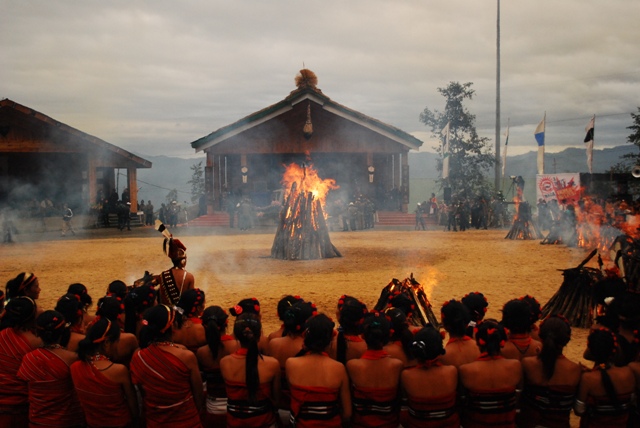
Amidst the dwindling need of preservation of tradition in the frenzied pace of the country it’s a pleasant surprise to see one State which is quite removed from this uncaring evolution. The first week of December finds Nagaland in a charming cultural milieu, tacitly holding onto its tribal legacy. The decade old Hornbill Festival of Nagaland celebrates its heritage with all major 16 tribes coming together to showcase the life, music and dance of their ancestors. Rapidly gaining the interest of travel enthusiasts, the festival is a great landing pad for exposure to vibrancy of the eastern edge of India. A popular tagline, ‘Festival of Festivals’ is suffixed by the locals, each time the Hornbill is mentioned.

Pleasantly spacious, one doesn’t find people rubbing shoulders to the point of discomfort. The area is spread sufficiently over a small hill, giving everyone space and time to explore themselves. A big amphitheatre allows for all the tribes to come in one by one and perform various dances, with themes ranging from harvest, war, fishing, weaving and other village activities. With everyone dressed in their traditional outfits, the place is a photographer’s delight. Each piece of intricate jewellery and hand-woven garments by themselves serve as brilliant objects of fascination. Infact some of the older performers from the villages still wear jewellery made of animal bones and teeth, brimming with pride of the ancestral acquisition. Habituated to being photographed often, the Nagas are extremely friendly and pose willingly for the curious visitors. Once, back in the morungs, one can often see tribes breaking out into their own little performances for the audience who has strayed away from the central rink.

Though it is easy to be transported into a whole new world with the tribal fanfare, some aspects stand to adulterate the experience, which can be left entirely pristine. Though inevitable, things like chilli eating contests, a sprawling shopping complex and a mammoth rock show lend themselves to some spuriousness for those who want to see the more raw form of life in Nagaland. Mildly disappointing as this maybe, one has to admit that the Rock Show at Hornbill is the Mecca to many young artistes from all over the country. It is a known fact the Nagas have an ear for western music, which is evident in their appreciation of some energetic head banging bands, a musical indulgence for the youth.

The Hornbill Festival is undeniably one of the most credible examples of the cultural heritage that India talks so proudly of. The relative inaccessibility of the destination adds to the fact that this is more pleasantly untouched as compared to the touristy stalwarts like Pushkar Mela in Rajasthan and Snake Boat Race of Alleppey. More than the unspoiled facets of the festival is the fact that the Nagas are so connected with their heritage. The history that is showcased dates back to a lifestyle which was so removed from modernisation and was still comfortable in its own cocoon of traditions such as head hunting amongst tribes as recent as the middle of the century. For the youth to still imbibe and be fiercely proud of their heritage is an example in itself. The Hornbill festival reiterates the diversity of culture in India at its full glory.
Some Interesting Facts –
- The festival is named after the Hornbill bird, the feather of which adorns the head gear of the tribes. Unfortunately the population of this bird is fast receding. It is still found in some areas of Assam. A single feather of the Hornbill can be bought for Rs 600/- or more.
- In some tribes, the cock feathers on a head gear depict the amount of alliances one might have had with women.
- In olden days the number of metal heads in a necklace represented the amount of heads slain by the person.

Travel tips while at the Hornbill Festival –
Since the festival is week-long, three days are sufficient to soak in all the merriment. The last 3 days are preferable as the crowd thins out and one can witness the last day of the bonfire. While in Kohima, the World War II Cemetery is worth a visit. Nagaland was one of the crucial locations where the Japanese army was restrained, though in lieu of 10,000 soldiers who lost their lives in the Battle of Kohima. A cemetery, still maintained by the British Government, holds testimony to the number of brave hearts from different religions that admirably fought for the Allied forces. A peace rally from Dimapur to Kohima marks the event during the festival.
The Khonoma Green Village, not too far from Kohima allows for a short peek into the Angami lifestyle. An ardous drive through a virtually non existing road is fast forgotten once you reach this beautiful village. One can take in the warm Naga hospitality at one of the homestays. One of the other destinations which catch the interest of birding enthusiasts is Benrue. South of Kohima, this is also accessible by road.
How to arrive –
Dimapur is the closest airport to Kohima. A 3 hour drive (about 75 kms) from Dimapur is the easiest way to get to Kohima. State run buses are also available for those who want to rough it out.
Where to stay –
Kohima, being the capital city is nothing like one would imagine the far-away land to be. Congested with traffic, one has to make do in the hotels or guest houses in the town area. Hotel Japfu is popular amongst tourists. Some of the quieter places are away from the town and require one to shuttle around in a cab. Be sure to book in advance as the hotels can tend to be busy at the time of Hornbill.
Packing Tips –
December can get pretty chilly in Kohima. Two layers of woollens and comfortable walking shoes are a must. If vegetarians have low threshold for the variety in your food, pick up pre mix packets to add some interest to your regular daal-chawal.
Shopping –
The shops at the Hornbill Festival are naturally a little pricy, even though the other option might be the State Emporium in town. Take a call between saving a few hundreds and lack of choice. It is recommended to give oneself a touristy allowance to loosen the strings for more options at the venue itself. Naga shawls, beaded necklaces, dress materials and spears are the common souvenirs to pick up.